

Defining Data Centers
Info adapted from resources by Athena, AI Now, Citizens Action Coalition, Data and Society, Kairos and Media Justice, and the Piedmont Environmental Council
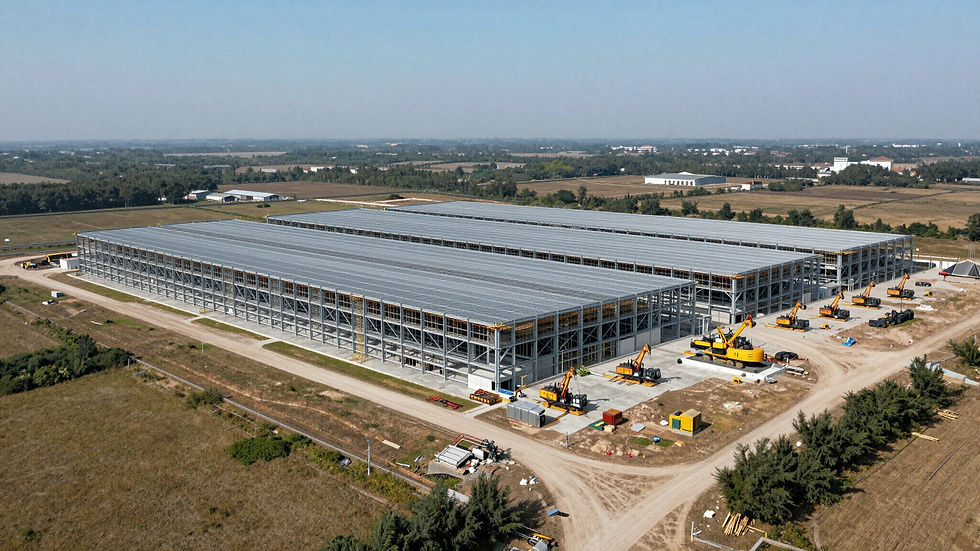
Data centers are giant warehouses that hold computer servers, chips, storage, and networking equipment (aka the hardware that enables computing and the “cloud”). They power everything from video streaming to social media to artificial intelligence (AI). Data centers have existed for a long time, for use by telecoms companies, hospital systems, universities, and the government, but we are currently seeing a rapid buildout of much larger, more energy-intensive facilities that are primarily used for AI, as well as cryptocurrency mining and cloud storage.
These noisy, hot warehouses require immense amounts of power to run, water to cool, and land to build on. The tech companies behind the global AI “race” have pushed this rampant expansion—with many companies speeding past local environmental, water, air quality, labor, and land regulations in the process, as well as basic community approvals or local buy-in. Many proposals are hidden behind Non Disclosure Agreements, so neighbors do not see the plans in advance until agreements are already set in stone.
Lots of data centers’ computing power is used for products that everyday people don’t want, such as data collection, manipulating our viewing and buying habits, targeted advertising, facial recognition, chatbots, and other tools that aim to replace people with grounded expertise.
Key Facts
Water
-
A single data center can use as much water as a city of 50,000 people.
-
Existing numbers are likely an undercount, as water for construction, cooling, and energy infrastructure is rarely considered in projections of data center water use.
-
Data centers can cause water contamination, by increasing concentrations of nitrates or other pollutants in groundwater and/or releasing PFAS that are added to cooling systems to prevent corrosion.
-
High-scale data hubs comsume nearly 5 million gallons of water daily and exert massive energy pulls. This strain inflates utility rates for local families while draining vital assets.
Rising Utility costs
-
Across the country, energy bills have gone up for regular ratepayers (individual households and small businesses), directly attributable to the buildout of data centers and associated energy infrastructure.
-
A recent analysis of the 13 states covered by PJM found a projected electricity bill increase of up to 60% by 2030—about $9.3 billion in extra costs—largely due to data‑center expansion.
-
Despite promises to pay their fair share, the industry has fought against obligations to ensure its costs aren’t passed along to ratepayers, in states including Georgia and Ohio.
Noise pollution
-
Data centers produce significant noise pollution primarily from diesel generators, gas turbines, and cooling (HVAC) systems. Noise impacts data center workers, nearby communities, and local wildlife.
-
Internal noise levels can reach up to 96 A-weighted decibels (dBA)—above 85 dBAs is considered harmful to hearing.
-
Diesel generators, used for backup power and sometimes as a primary power source, are often allowed to exceed local noise limits in “emergency” scenarios.
Air pollution
-
Data centers could create an estimated $20 billion yearly public health burden due to air pollution from fossil energy generation, often disproportionately impacting already vulnerable communities.
-
Pollution comes in many forms, including but not limited to: CO2, NOx, and SO2.
No transparency
-
Tech corporations often push these projects through with little transparency, so the public doesn’t know their potential impact on the grid, household utility bills, air quality or local budget. Often those deals are done under project code names or subsidiary names, especially Limited Liability Companies (LLCs), often preventing communities from having a chance to weigh in on these projects before they’re greenlit.
emergency services
-
Data centers threaten to strain rural, volunteer emergency and fire services with dangerous equipment and onsite fuel storage. They present hazardous risks of fire and explosion from gas pipeline hookups, carbon capture wells, nuclear projects, and lithium battery use that rural emergency services may not be sufficiently resourced to address. (Source: Rural Coalition).


Skyrocketing Utility Costs
High-scale data hubs consume nearly 5 million gallons of water daily and exert massive energy pulls. This strain inflates utility rates for local families while draining vital assets.
Threats to Health
Constant auditory hums of dangerously high decibel levels, impaired air quality from off-grid generators, and light pollution disrupting circadian rhythms of residents and local wildlife; these are but a few of the long list of health threats a data center would bring to Bowie County residents.
Economic Development for Whom?
The promise of job creation dries up quickly after the construction phase, with little positive impact for our local economy. Many risks, few rewards.
Skyrocketing Utility Costs
High-scale data hubs consume nearly 5 million gallons of water daily and exert massive energy pulls. This strain inflates utility rates for local families while draining vital assets.
Threats to Health
Constant auditory hums of dangerously high decibel levels, impaired air quality from off-grid generators, and light pollution disrupting circadian rhythms of residents and local wildlife; these are but a few of the long list of health threats a data center would bring to Bowie County residents.
Economic Development for Whom?
The promise of job creation dries up quickly after the construction phase, with little positive impact for our local economy. Many risks, few rewards.
News and Updates

Scientists Have Found an Alarming Environmental Impact of Vast Data Centers: Heat
Mar 30, 2026 | CNN
The vast data centers that power artificial intelligence guzzle huge amounts of energy but they also have another alarming impact, according to new research. They are creating “heat islands,” warming the land around them by up to 16 degrees Fahrenheit, and making life hotter for more than 340 million people.